A neuroactive peptide investigated in relation to BDNF, cerebral ischaemia, neural plasticity and the inflammatory response
Overview
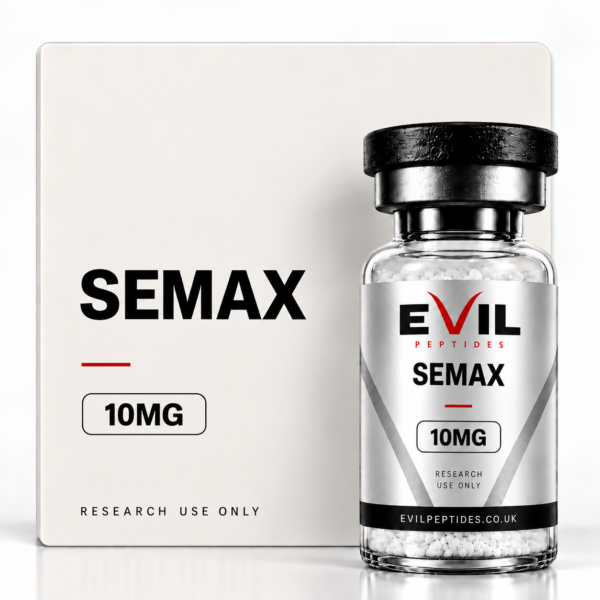
Semax is a short synthetic peptide made up of seven amino acids, with the sequence Met-Glu-His-Phe-Pro-Gly-Pro. Published work describes it as a derivative of ACTH(4-10) or ACTH(4-7) to which a Pro-Gly-Pro unit has been appended, a modification intended to confer greater biological stability than shorter ACTH segments possess [1,2]. While its structure traces back to the ACTH pathway, Semax is not full ACTH, nor does the literature present it as a classic hormonal peptide of the stress axis. Most research attention has centred on the nervous system: neurotrophic factors, responses to ischaemic injury, gene expression, neuroinflammation and synaptic plasticity [1-6]. The body of Semax literature comprises numerous preclinical studies alongside clinical publications, predominantly Russian and in some cases fairly dated. The biological rationale is therefore of genuine interest, yet it carries methodological and geographical limitations when measured against the standards of contemporary multicentre trials [5,7].
Biological Mechanism
The BDNF-TrkB axis is one of the principal themes in Semax research. BDNF is a neurotrophic factor that participates in neuronal survival, synaptic plasticity, learning and memory, and TrkB is the main receptor through which it mediates a number of its effects. In a rat study, Semax was found to influence BDNF levels and TrkB expression within the hippocampus [1]. A separate rat study reported that Semax bound specifically and reversibly to cell membranes in the basal forebrain and elevated BDNF levels in that region following experimental exposure [2]. Because the basal forebrain is associated with cholinergic systems, attention and learning, this observation drew interest from a cognitive-research perspective. Beyond BDNF, Semax has also been examined in relation to the immune and inflammatory response that follows cerebral injury: gene-expression work in cerebral ischaemia models demonstrated altered expression of genes linked to the immune system, blood vessels, cytokines and stress responses [3,4].
Research Evidence
Across several animal studies using cerebral ischaemia models, Semax displayed neuroprotective effects. A genome-wide transcriptional analysis published in 2014 found that Semax influenced gene expression in the rat brain after focal ischaemia, predominantly within immune and vascular pathways [3]. A 2017 study proposed that part of its activity may be mediated through neuroimmune crosstalk, meaning the exchange of signals between the nervous and immune systems, having identified shifts in the expression of genes for immune response, cytokines and injury-related proteins [4]. A proteomic study published in 2021, based on an ischaemia-reperfusion model, reported effects on proteins connected with inflammation, cell death and neural recovery [5]. In humans, clinical publications on Semax exist in the setting of ischaemic stroke: a 1997 clinical study assessed it during the acute phase of hemispheric stroke, and a 2018 study examined patients at various stages of ischaemic stroke with reference to BDNF and functional measures [6,7]. These studies are pertinent, but they warrant cautious interpretation given their sample sizes, language, availability of detail and methodology relative to present-day standards.
BDNF, TrkB and Neural Plasticity
Of the themes running through the Semax literature, its relationship with BDNF is among the most significant. BDNF contributes to synaptic plasticity, neuronal survival, learning and memory, while TrkB ranks among the key receptors through which BDNF acts. Rat studies found that Semax influenced BDNF levels and TrkB expression in brain regions associated with learning and neural function [1,2]. Even so, these BDNF findings call for careful interpretation. A rise in BDNF in an animal model is not proof of cognitive improvement in healthy humans; what it does suggest is neurotrophic potential and a capacity for the peptide to influence the environment in which neurons recover. This makes Semax particularly relevant to research on neural plasticity following stress, ischaemia or injury, rather than merely to popular talk of "improving focus." The genomic studies of cerebral ischaemia contribute a further, important dimension, showing that Semax is linked not only to BDNF but also to immune and vascular pathways after cerebral injury [3,4]. After a stroke or an experimental cerebral occlusion, tissue damage is not driven by oxygen deprivation alone: it also involves an inflammatory response, immune-cell infiltration, disruption of the blood-brain barrier, shifts in chemokine and cytokine expression and changes in glial cells. The influence of Semax on immune genes raises the possibility that it forms part of the brain's wider response to injury. Clinical studies published in Russian or from regional settings provide intriguing data in ischaemic stroke and neurological rehabilitation [6,7]. They do, however, carry recognised limitations: several publications are old, samples are small, full protocols are often hard to obtain, and comparison with modern late-phase trial standards is difficult. The human evidence therefore does not match the strength of the animal and laboratory mechanistic data. It justifies continued research interest but falls short of a comprehensive picture of efficacy, safety and appropriate populations.
Safety & Regulation
Safety data for Semax are considerably less extensive than for medicines that have progressed through large global development programmes. Clinical reports of tolerability exist, but there is no large, long-term, multi-population dataset capable of assessing rare risks or interactions across the range of neurological and psychiatric conditions. The FDA observes that compounded preparations containing Semax may raise concerns relating to immunogenicity, aggregation, peptide-related impurities and characterisation of the active substance, and that human safety data for the proposed routes of exposure are limited or insufficient [8]. From a research perspective, then, Semax is a valuable peptide for understanding neurotrophins, neuroinflammation and ischaemia; from a clinical perspective, the evidence is not sufficient to support broad conclusions about cognitive improvement or the general treatment of neurological conditions.
Brain Penetration and Biological Breakdown
A feature that sets Semax apart from many neural peptides is the attention some publications have given to the intranasal route of administration. Preclinical data indicate that the peptide or its metabolites are able to reach the nervous system, but that they are also degraded relatively quickly [1,2]. Such degradation need not be a drawback, as short metabolites may themselves be active, yet it complicates any definitive account of mechanism. When assessing a possible influence on cognition, three levels should be kept distinct: effects on neurotrophic factors, effects on recovery after injury, and effects in healthy people. The more robust evidence sits within the first two, particularly in ischaemia models and in measures of BDNF, TrkB and the neural immune response [1-5]. Broad claims of improved attention or memory in healthy people, by contrast, would require larger, controlled and more independent studies. On safety too, regional data or usage experience within a single country cannot stand in for comprehensive regulatory evaluation. Questions such as interactions with psychiatric medications, effects across different neurological diseases, prolonged exposure and consistency of manufacture remain significant [8]. Semax is thus an intriguing neuroactive peptide, although the degree of confidence varies considerably from one research area to another. A further distinction lies between acute neuroprotection and sustained cognitive improvement: a substance might limit damage after ischaemia in an animal model without necessarily enhancing learning in a healthy person. The Semax findings should therefore be weighed within the specific clinical context in which each was tested, rather than grouped under the single broad heading of "nootropics."
Summary
Semax is a neuroactive peptide investigated principally in relation to the BDNF-TrkB pathways, cerebral ischaemia and the neuroinflammatory response [1-5]. Clinical publications exist but are limited in scope and methodology [6,7], and open questions remain about effect size, long-term safety, formulation quality and the reproducibility of the findings. This material is supplied for laboratory research use only.
Selected Research Sources
- Dolotov O.V. et al. Semax, an analog of ACTH(4-10) with cognitive effects, regulates BDNF and TrkB expression in the rat hippocampus. Brain Research, 2006. DOI: 10.1016/j.brainres.2006.07.108. sciencedirect.com
- Dolotov O.V. et al. Semax, an analogue of adrenocorticotropin (4-10), binds specifically and increases levels of brain-derived neurotrophic factor protein in rat basal forebrain. Journal of Neurochemistry, 2006. PMID: 16635254
- Medvedeva E.V. et al. The peptide Semax affects the expression of genes related to the immune and vascular systems in rat brain focal ischemia. BMC Genomics, 2014. PMID: 24661604
- Medvedeva E.V. et al. Semax regulates expression of immune response genes during ischemic brain injury in rats. Molecular Genetics and Genomics, 2017. PMID: 28255762
- Sudarkina O.Y. et al. Brain Protein Expression Profile Confirms the Protective Effect of Semax in a Rat Model of Cerebral Ischemia-Reperfusion. International Journal of Molecular Sciences, 2021. PMID: 34201112
- Gusev E.I. et al. Effectiveness of Semax in acute period of hemispheric ischemic stroke. Clinical and electrophysiological study, 1997. PMID: 11517472
- Gusev E.I. et al. The efficacy of Semax in the treatment of patients at different stages of ischemic stroke, 2018. PMID: 29798983
- U.S. Food and Drug Administration. Safety risks associated with certain bulk drug substances nominated for use in compounding. Entry for Semax. FDA.gov

Reviews
There are no reviews yet.